Smokers fail to appreciate the benefits of switching to e-cigarettes

Smoking tobacco is the single largest cause of death , disability and social inequality in health in the UK , costing the NHS 5 billion a year.

Many smokers have switched to vaping (e-cigarettes) , or have used the devices temporarily before quitting nicotine for good.

But are e-cigarettes a safer option?

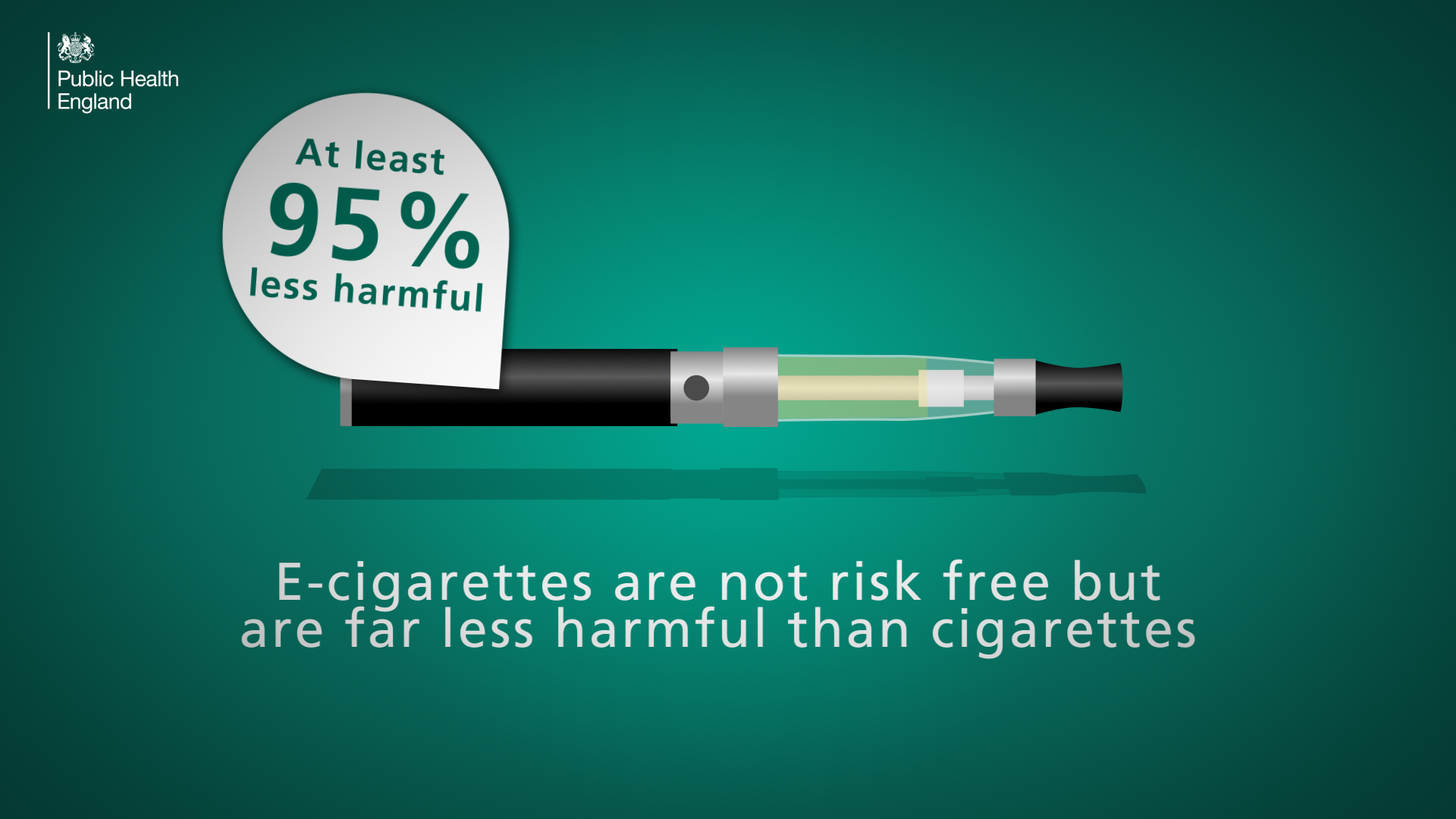
If you ask Public Health England , who carried out a review of the evidence on e-cigarettes and health in 2015 and again in 2018, they will tell you that e-cigarettes , which do not burn tobacco and produce smoke, but heat a liquid to produce vapour instead , are ‘at least 95% safer’ than tobacco cigarettes. 
On the other hand, If you ask UK smokers , only about half will tell you that vaping is even safer at all. According to a survey from Action on Smoking and Health, just 53% of UK smokers believe that e-cigarettes are less harmful than tobacco cigarettes. 22% think e-cigarettes are more or equally as harmful as tobacco cigarettes whilst 22% don’t know. Only a quarter chose the correct response (a lot less harmful).
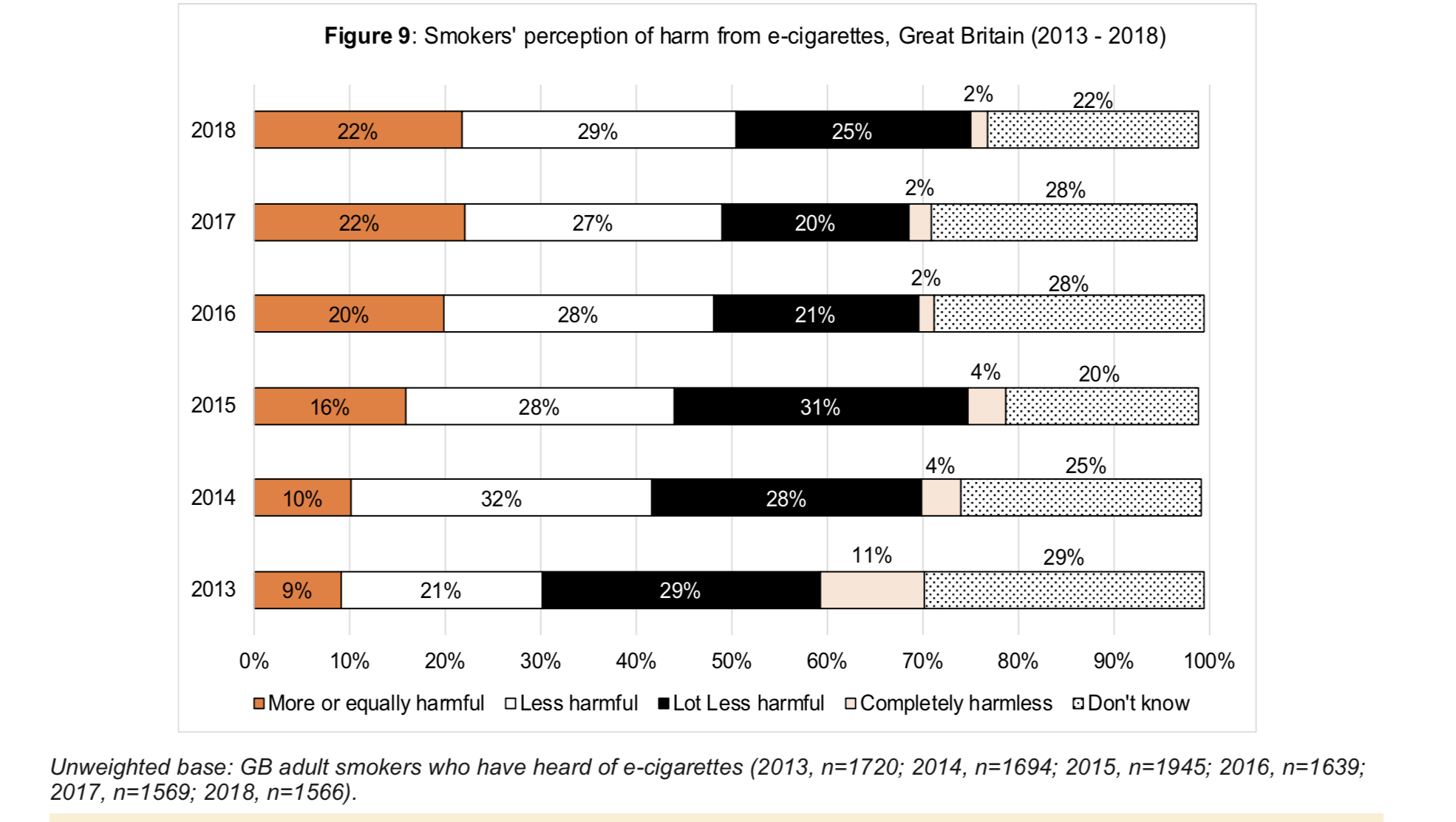
Source: Action on Smoking and Health – Use of e-cigarettes (vapourisers) among adults in Great Britain , September 2018

Let that sink in for a minute…

22% of current UK smokers (about 2.2 million people) believe that e-cigarettes are just as or more harmful than tobacco cigarettes. Public Health England says that they are 95% less harmful. This is absolutely astonishing.

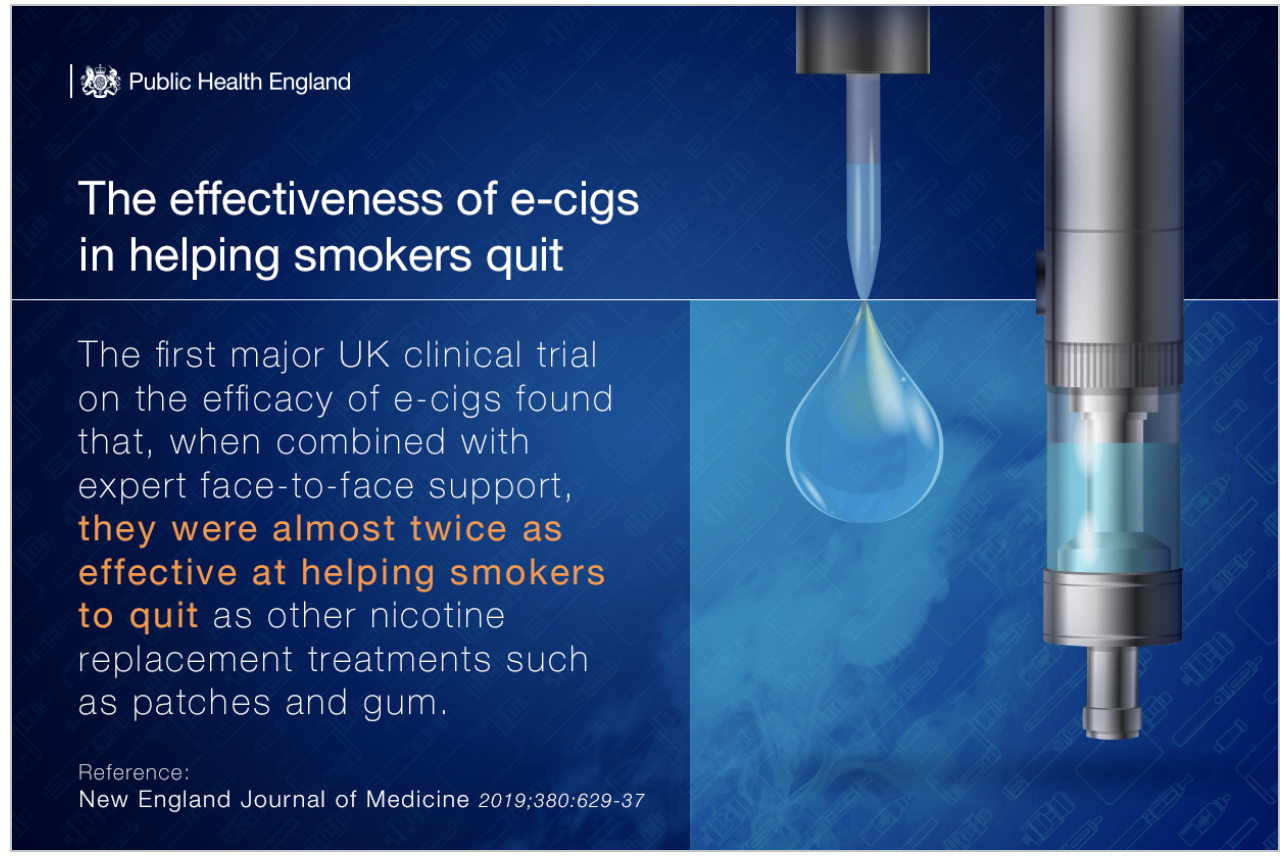
This is especially frustrating given that a recent clinical trial showed e-cigarettes to be nearly twice as effective as conventional nicotine replacement therapies ( patches , gums, etc) for helping smokers quit.
E-cigarettes are not harm free – If you don’t smoke , don’t take up vaping. The 95% figure has been controversial, as the science on vaping is still limited ( particularly lacking are long term studies). However, following their second evidence review, PHE stated that the 95% figure “remains a good way to communicate the large difference in relative risk unambiguously, so that more smokers are encouraged to make the switch”. 

Whether the number is 95%, 90%, or 85% less, false perceptions of e-cigarettes constitute a glaring missed opportunity to bring transformative change to the health of smokers in the UK. 

For more information on E – cigarettes, see :

https://www.nhs.uk/smokefree/help-and-advice/e-cigarettes (general info)
https://publichealthmatters.blog.gov.uk/2018/02/20/clearing-up-some-myths-around-e-cigarettes/. ( myth busting)
https://www.gov.uk/government/publications/e-cigarettes-and-heated-tobacco-products-evidence-review ( 2018 evidence review)
https://www.gov.uk/government/publications/e-cigarettes-and-heated-tobacco-products-evidence-review/evidence-review-of-e-cigarettes-and-heated-tobacco-products-2018-executive-summary  ( executive summary of 2018 updated evidence review)

What is a ‘Nutritionist’?


Many people call themselves nutritionists. Some are more qualified to do so than others. So what is a nutritionist, anyway?


I have a few weeks left of my Master’s degree in Nutrition for Global Health at the London School of Hygiene and Tropical Medicine. Provided I receive a passing grade in my research project which I am currently working on,  I can join the UK Voluntary Register of Nutritionists. This means I gain the title Registered Associate Nutritionist (ANutr). This is because the course I am doing is accredited by the Association for Nutrition (AfN).

From the AfN website:
“The Voluntary Register of Nutritionists (UKVRN) is a register of competent, qualified nutrition professionals who meet our rigorously applied standards for scientifically sound evidence-based nutrition and its use in practice.  The UK Voluntary Register of Nutritionists is the only register of qualified nutritionists recognised by Public Health EnglandNHS Choices and NHS Careers.”

If I work as a nutritionist for at least 3 years I can then apply to be a fully Registered Nutritionist (RNutr). To become an Associate Nutritionist , one must complete an AfN accredited Bachelor’s or Master’s degree .This takes at least a year of full time study.  You must also do CPD ( Continuing Professional Development) , such as completing further accredited training or attending conferences. So why do people who have not done so call themselves nutritionists?

Unfortunately, the title ‘Nutritionist’ is not protected by law. This means anyone can call themselves this, regardless of their training. So someone who has qualified as a personal trainer might decide to call themselves a nutritionist, even if they have no education in nutrition or have just completed a short non-accredited online course. I have unfortunately seen this first hand on numerous occasions.

This situation is even more of a minefield because there is another group of people in the UK called ‘Nutritional Therapists’, who will often give themselves the ‘Nutritionist’ title when advertising their services. These people have received a ‘Diploma in Nutritional Therapy’ from an organisation called the ‘Institute of Optimum Nutrition’. This is not a recognised university and nutritional therapy is seen to be a part of the ‘complementary medicine’ world (alongside homeopathy, reflexology, and so on). Sadly, undercover investigations into Nutritional Therapists by Which! Magazine have shown them to give dangerous, non evidence-based advice and use forms of ‘quack’ analysis like Iridology. To quote Which! :

“Several of the therapists used non-evidence based testing to ‘diagnose’ symptoms.  One of the researchers – who had been trying to conceive unsuccessfully for over a year – was diagnosed with a ‘leathery bowel’ by a therapist who used Iridology – looking at iris patterns, colour and other characteristics of the eye to diagnose symptoms.”

I don’t intend to offend Nutritional Therapists, but as the Diploma is not an AfN-accredited course at a reputable university, there is simply no regulation over what is taught and as a result much of the content may be outdated/ non evidence-based / factually incorrect. Nutritional Therapy and its origins are covered in detail in ‘Bad Science’ by Ben Goldacre.

If you want to consult with a nutritionist on your diet , speak with an ANutr or RNutr. If it relates to a diagnosed medical condition, go to your GP and ask to be referred to a dietician. Dieticians are the only people in the UK trained to give medical advice related to diet. Nutrition is a complex and nuanced subject and needs extensive study from an accredited institution to be understood well.

References:

  1. http://www.associationfornutrition.org/
  2. https://www.which.co.uk/news/2012/01/nutritional-therapists-gambling-with-your-health-276653/ (Which! investigation)
  3. https://www.bda.uk.com/improvinghealth/yourhealth/dietitian_nutritionist ( dietician vs nutritionist vs nutritional therapist)

This is the first post on my new blog. I’m just getting this new blog going, so stay tuned for more. Subscribe below to get notified when I post new updates.